Smith 4D MAG Review: Lenses, Fit and Verdict
Affiliate disclosure: As an Amazon Associate we earn from qualifying purchases. Some links below are affiliate links, see our full disclosure. This breakdown is based on our independent research of current-season specifications and aggregated expert and user feedback.
The quick verdict: The sharpest all-around optics package in skiing: ChromaPop clarity, a lens that curves under your sightline, and a second lens in the box. ~$355 list, past-season colorways ~$210-250 on sale
Overview
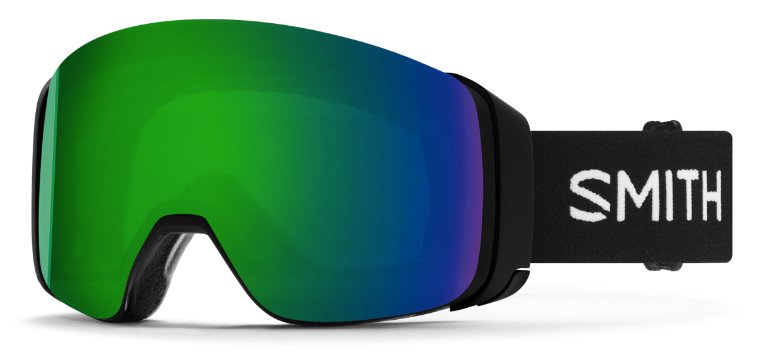
The 4D MAG is Smith’s flagship, and its signature trick is the BirdsEye View lens: the bottom edge curves inward, extending your field of vision downward by a claimed 25%. In practice that means you can see your ski tips and the roll-over below you without dropping your chin. Add ChromaPop contrast filtering, which reviewers consistently place among the best optics in the category, and a magnetic MAG lens-change system backed up by two mechanical locks, and you have the goggle the rest of the market gets measured against.
Where It Shines
- Class-leading clarity and contrast in mixed and flat light
- Extra downward field of view is genuinely useful in bumps, trees, and steeps
- Two ChromaPop lenses included, so the price covers the full quiver
- Glove-friendly magnetic lens change with a secure mechanical lock
Tradeoffs to Know
- Among the most expensive goggles on the market
- The curved lower lens edge can distort slightly at the extreme bottom of your vision until you adjust
- Large frame profile overwhelms smaller faces; try the smaller Smith 4D MAG S
Who It’s For
Skiers and riders who want the best optics available and would rather buy one complete system than upgrade piecemeal. If you ski varied terrain where seeing the snow surface below you matters, the BirdsEye lens is more than a gimmick.
Key Specs and Sizes
Figures are approximate and come from smithoptics.com, cross-checked against REI, evo and Blister’s published review; Smith lists no weight.
| Spec | Detail |
|---|---|
| Frame fit | Medium (4D MAG); Small for the 4D MAG S; Large for the 4D MAG XL; Low Bridge Fit versions of each |
| Lens shape | Spherical ChromaPop with BirdsEye Vision lower curve, claimed 25% more field of view than the I/O MAG |
| Lenses in box | Two: a bright-light ChromaPop lens installed plus a low-light Storm lens as the bonus |
| Bright lens options (VLT) | Sun Green Mirror 9%, Sun Black 12%, Sun Platinum Mirror 13%, Sun Red Mirror 16%, Everyday Green / Violet / Blue / Rose Gold Mirror 23%, Everyday Red Mirror 25% |
| Bonus lens options (VLT) | Storm Rose Flash 50%, Storm Blue Sensor Mirror 55%, Storm Yellow Flash 65%, Storm Amber 67% (pairing depends on colorway) |
| Lens change | MAG magnetic system, seven contact points, two mechanical locks under the frame |
| Coatings | 5X anti-fog inner lens, hydrophobic outer coating, 100% UV protection |
| Foam and strap | 3-layer DriWix face foam; ultra-wide silicone-backed strap with QuickFit clip adjustment |
| Helmet | Helmet compatible; AirEvac venting designed around Smith helmets |
| Included extras | Hard case, microfiber bag with spare-lens sleeve, gogglesoc or lens protector |
| Warranty | Smith limited lifetime warranty |
The lens is a carbonic-x spherical with Smith’s Tapered Lens Technology to cut distortion. List price rose to about $355 for 2025/26 (recent seasons sat at $320-340), and the 4D MAG S carries the same list. Current colorways rarely discount before spring, but past-season colorways show up around $210-250 at REI and similar retailers.
Sizing and Fit
Smith sells the BirdsEye frame in three sizes, so choose by face width rather than by name. The standard 4D MAG is a medium fit and suits most adult faces; the Smith 4D MAG S is a small fit for narrower faces, many women and teens; and the Smith 4D MAG XL is the large. Each size also comes in a Low Bridge Fit, which adds foam at the nose for lower nose bridges and higher cheekbones.
How it runs: Blister’s reviewers found the frame stiffer than older Smith goggles, so it needs careful strap tension to close a small gap at the nose, and the extended lower lens sits close to the nose on some faces. Try it with your helmet before committing: the curved upper edge can gap under flat-brimmed helmets, though it integrated cleanly with Smith, Giro, Sweet Protection and POC lids in Blister’s testing.
Two things it won’t suit: Smith doesn’t rate the 4D MAG as OTG, so glasses wearers should look elsewhere, and the standard lenses are neither photochromic nor polarized unless you buy the pricier Pro Photochromic version. Expect to swap lenses by hand when the light changes.
Who Should Skip It
Three kinds of buyer will be happier elsewhere. If you’d rather not fiddle with lens swaps at all, the Julbo Lightyear (about $300-320) uses a REACTIV photochromic lens that adjusts itself across the day. If the roughly $355 list is simply too much, the Oakley Flight Deck M (about $170-240 list, often $150-200 on sale) delivers excellent Prizm optics for far less, and the Glade Adapt 2 (about $150-170 list) gives you a photochromic lens at under half the Smith’s price. And if you only ride a handful of days a year, the Smith Frontier at about $45 is a sensible entry point.
4D MAG vs. Anon M4S vs. Oakley Flight Deck M
The Anon M4S (about $340 list, often $240 on sale) matches the Smith on price and also ships with two lenses, but its magnetic swap uses no mechanical lock, it adds the MFI magnetic face mask, and it lets you choose between toric and cylindrical lens shapes. The Oakley Flight Deck M is cheaper by a wide margin, has a huge rimless field of view, and uses Prizm tints that reviewers rate on par with ChromaPop, but it comes with one lens and swaps are a two-handed, non-magnetic job. The 4D MAG’s edge is the BirdsEye downward view and the most secure quick-change system of the three. Pick the 4D MAG if you want the best downward visibility and a locked-in two-lens system; pick the Anon M4S if you want magnetic convenience plus a face mask and tend to find it on sale; pick the Flight Deck M if you want top-tier optics on a tighter budget and can live with one lens.
Frequently Asked Questions
Is the Smith 4D MAG worth the money?
Based on aggregated reviews, yes if you value the extra downward field of view and want two ChromaPop lenses in the box, since buying a second lens separately for a cheaper goggle narrows the price gap. REI shoppers rate it 4.6 out of 5 across more than 800 reviews.
What size Smith 4D MAG should I get?
The standard 4D MAG is a medium fit for most adult faces. Go with the 4D MAG S for a smaller or narrower face and the 4D MAG XL for a large face, and pick the Low Bridge Fit if goggles usually leave a gap at your nose.
Smith 4D MAG or I/O MAG?
The Smith I/O MAG uses the same ChromaPop lenses and magnetic change system for less money; the 4D MAG adds the BirdsEye lower curve for a claimed 25% more field of view. If you don’t care about seeing your ski tips, the I/O MAG is the better value, as our I/O MAG vs. Flight Deck comparison covers.
Can you wear glasses under the Smith 4D MAG?
Smith does not list the 4D MAG as an OTG (over-the-glasses) goggle, and the lens sits close to the face, so most glasses wearers should look at a dedicated OTG frame or prescription inserts instead.
How It Compares
See how it stacks up in our full guide: Ski Goggle Lens Guide 2026-27. Other picks from that list: Anon M4S · Julbo Lightyear · Glade Adapt 2 · Oakley Flight Deck M.