Julbo Lightyear Review: Specs, Fit and Verdict
Affiliate disclosure: As an Amazon Associate we earn from qualifying purchases. Some links below are affiliate links, see our full disclosure. This breakdown is based on our independent research of current-season specifications and aggregated expert and user feedback.
The quick verdict: The widest photochromic range made, in a frameless goggle that vents itself. One lens really can do every condition here. ~$300-320 list with a REACTIV lens, rarely discounted
Overview
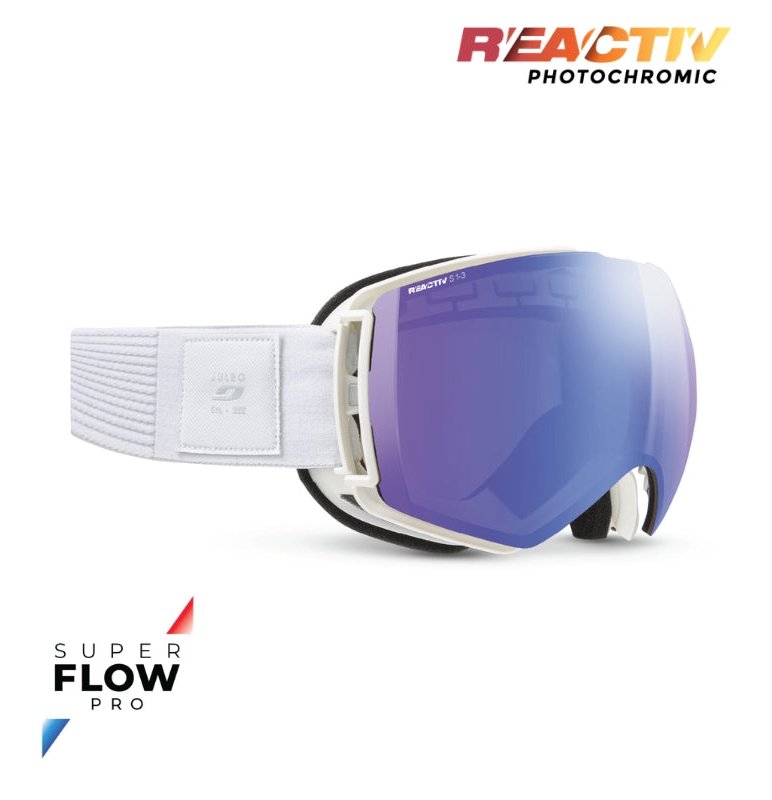
Julbo has made photochromic lenses for mountaineering glasses for decades, and the Lightyear brings that expertise to a flagship ski goggle. Its REACTIV 0-4 High Contrast lens sweeps from a near-clear category 0 to a dark category 4, the broadest swing of any snow lens, and it adjusts in well under a minute as clouds move through. The other headline feature is SuperFlow Pro: the XL lens hinges forward on the magnetic SuperFlow Pro system, opening a vent gap that dumps heat and moisture, then locks back in place with magnets. Skinning uphill, bootpacking, or standing in a lift line in spring sun, you pop the lens forward and simply do not fog.
Where It Shines
- Category 0-4 photochromic range covers whiteout to glacier sun with one lens
- SuperFlow Pro venting all but eliminates fogging during high-output moments
- Nothing to swap, carry, or lose; the goggle manages itself
- High-contrast tuning keeps terrain detail visible as the tint shifts
Tradeoffs to Know
- Julbo says REACTIV is not temperature sensitive, but a full tint swing still takes roughly 30 to 45 seconds
- At its darkest it stops just short of a dedicated cat-4 sun lens; the very sun-sensitive may want darker for glaciers
- No second lens in the box, though the point is that you should not need one
Who It’s For
Ski tourers, storm chasers, and anyone who refuses to carry a spare lens. If your ski day runs from gray dawn to blinding afternoon and you want to think about your goggle exactly zero times, this is the one.
Key Specs and Sizes
Figures are approximate and drawn from Julbo’s published product pages (via julbo.us) and retailer listings at evo and Alpine Ascents. The Lightyear comes in one frame size (Julbo calls it XL, evo lists it as Large) plus a separate OTG version.
| Spec | Detail |
|---|---|
| Lens shape and size | Spherical double lens, frameless; about 165mm wide and 92mm tall |
| REACTIV 0-4 High Contrast | Photochromic cat. 0 to 4; roughly 80% VLT at its clearest to 7% at its darkest; amber-red base |
| REACTIV 1-3 High Contrast | Photochromic cat. 1 to 3; roughly 75% to 17% VLT; amber base for flat light |
| REACTIV 1-3 HD / Glare Control | Photochromic cat. 1 to 3; roughly 45% to 12% VLT |
| REACTIV 2-4 Polarized | Photochromic cat. 2 to 4; retailers list roughly 40% to 7% VLT |
| Lens material | Trivex with the photochromic formula cast into the lens, not a coating |
| SuperFlow Pro venting | Magnetic hinge; lens pushes forward to open an air gap, locks back with magnets, glove-friendly |
| Frame fit | One size, XL/Large frame, standard adult fit; dual-density face foam |
| OTG | Not on the standard model (not RX-clip compatible); a Lightyear OTG version uses thermoformed foam for glasses |
| Helmet compatibility | Yes; two strap loops per side allow symmetrical adjustment to most helmet sizes |
| Strap | 45mm wide, double-adjustable, three full-length silicone strips, no rear clip |
| Anti-fog | Inner anti-fog coating plus frame and lens vents; 90-day no-fog guarantee on julbo.us purchases |
| Weight | About 130 to 140g depending on which Julbo page you read |
| Warranty | Limited lifetime warranty for the original owner; lifetime guarantee on the photochromic effect |
| Price | About $300 to 320 list with a REACTIV lens; OTG version about $315; Spectron 3 fixed-lens version about $200 |
Every version is the same frameless shell, strap, foam and SuperFlow Pro hinge; only the lens changes. Spare REACTIV lenses run roughly $160 to 170. Julbo does not state a country of manufacture on its product pages. Discounts on current-season REACTIV versions are rare; the fixed-tint Spectron 3 model is the budget route into the frame.
Sizing and Fit
There is only one size, so the question is whether your face is big enough for it. The lens is around 165mm across and 92mm tall, the same oversize class as the Smith 4D MAG and the Anon M4S. Reviewers with average-to-large heads describe the seal as flush and gap-free; the consistent caveat in aggregated reviews is that smaller heads find the frame wide at the temples and tall at the brow. If larges normally swim on you, try it on first.
Helmet pairing is easy. The 45mm strap has full-length silicone strips and adjusts from both sides, so it centres over almost any helmet. There is no rear clip, so use your helmet’s own retainer on windy days. The foam is breathable enough that reviewers note cold air creeping through on exposed lifts, the flip side of a goggle that vents this well. Glasses wearers need the Lightyear OTG; the standard frame is not RX-clip compatible.
Lens choice is the real decision. The 0-4 High Contrast is for days that start in a storm and end on a sunlit glacier. The 1-3 High Contrast suits resort skiers who rarely see cat-4 light; it never goes fully clear but tops out brighter than most fixed low-light lenses. The 2-4 Polarized is for spring and high-altitude skiers who hate glare and never ski at dusk.
Who Should Skip It
Skip the Lightyear if you have a small or narrow face, because there is no medium version; the Oakley Flight Deck M gives a similar rimless look in a smaller frame. Skip it if you want the biggest, fastest-changing photochromic for the least money; the Glade Adapt 2 delivers a photochromic lens for well under half the price, and the gap pays for a second pair of gloves. Skip it if you prize instant lens changes over a self-adjusting tint; the REACTIV takes tens of seconds to shift, while the magnetic swap on the Smith 4D MAG or Anon M4S takes a moment.
Lightyear vs. Glade Adapt 2 vs. Smith 4D MAG
Three different answers to changing light. The Glade Adapt 2 at about $115 is the budget photochromic: a narrower tint range and a simpler frame, but the same no-swap convenience for a third of the price. The Smith 4D MAG at roughly $355 list goes the other way, with two fixed ChromaPop lenses, a magnetic swap system and a downward-curving BirdsEye lens. The Lightyear at about $300 to 320 sits between them in price and alone in approach: the widest photochromic range on the market in a frame that also vents mechanically. Pick the Adapt 2 if you want photochromic convenience on a tight budget and your light swings are moderate. Pick the 4D MAG if you want the best optics in any one condition and do not mind carrying a spare lens. Pick the Lightyear if you tour, chase storms, or simply never want to think about lenses again.
Frequently Asked Questions
How fast does the Julbo REACTIV lens change?
Julbo says the lens reacts in seconds and is not temperature sensitive; aggregated reviews put a full swing from clear to dark, or back, at roughly 30 to 45 seconds. That is quick enough for a cloud bank or a gondola ride, not for ducking from open sun into dense trees.
Is the Julbo Lightyear too big for small faces?
It can be. The 165mm by 92mm lens is sized for medium-to-large faces and Julbo makes it in one size only. Smaller heads often find the temples wide and the brow tall; the Oakley Flight Deck M is the safer rimless choice for a narrow face.
Julbo Lightyear or Smith 4D MAG?
The Smith 4D MAG gives sharper, more specialised optics in each of its two included lenses and swaps in seconds. The Lightyear covers more conditions with a single lens and vents better for uphill work. Resort-only skiers lean 4D MAG; tourers and all-day storm skiers lean Lightyear.
Does the Julbo Lightyear fog?
Rarely. With frame vents, an inner anti-fog coating and the SuperFlow Pro hinge you can crack open with gloves on, reviewers report near-zero fogging unless a neck gaiter funnels breath inside. Julbo backs it with a 90-day no-fog guarantee on direct purchases.
How It Compares
See how it stacks up in our full guide: Ski Goggle Lens Guide 2026-27. Other picks from that list: Smith 4D MAG · Anon M4S · Glade Adapt 2 · Oakley Flight Deck M.