Oakley Flight Deck M Review: Lenses, Sizing and Verdict
Affiliate disclosure: As an Amazon Associate we earn from qualifying purchases. Some links below are affiliate links, see our full disclosure. This breakdown is based on our independent research of current-season specifications and aggregated expert and user feedback.
The quick verdict: A decade-old design that still delivers one of the widest views and sharpest fixed lenses in skiing, now with Prizm tints for every sky. ~$170 to 240 list, typically ~$150 to 200 on sale
Overview
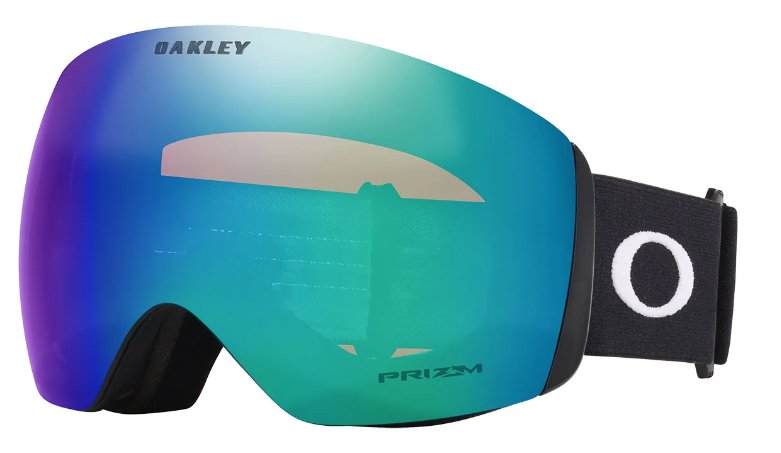
Oakley modeled the Flight Deck on a fighter jet canopy, and the metaphor holds up: no frame in your peripheral vision, just lens from cheekbone to eyebrow. The M is the mid-size fit, sized for most faces and most helmets. Prizm lens chemistry sharpens snow contrast the way ChromaPop and Perceive do, and the tint catalog is enormous: Black Iridium at 5.5% VLT for glaciers, the versatile Argon and Sage tints in the middle, Iced Iridium for storm days, and Prizm Clear at 65% for night laps. The rimless lens swaps via the Ridgelock rail system, secure and weathertight, if not fast.
Where It Shines
- Huge unobstructed field of view for a mid-size goggle
- Prizm tints are among the best fixed lenses made, especially in bright and mixed light
- Proven design with wide helmet compatibility and a deep replacement-lens catalog
- Regularly discounted below its list price, strong value for the optics
Tradeoffs to Know
- Ridgelock swaps take a minute and bare fingers; this is not an on-hill system like the M4S
- Only one lens in the box at the standard price
- No photochromic option; you commit to a tint per outing
Who It’s For
Skiers who know their home mountain’s light and want maximum optical quality per dollar in that condition. Buy it with Prizm Argon or Sage for all-round use, or grab a second lens on sale and swap in the lodge, not on the lift.
Key Specs and Sizes
Figures are approximate and drawn from Oakley’s published product details (via oakley.com) as reproduced by evo, Public Lands and other retailers, plus the Prizm Snow light-transmission chart as published by SportRx. The Flight Deck M comes in one frame size; the Flight Deck L is the bigger sibling, not a size option within the M.
| Spec | Detail |
|---|---|
| Lens shape and size | Spherical, rimless shield lens; mid-size frame (the M was formerly sold as the Flight Deck XM) |
| Prizm Snow tints (VLT) | Black Iridium 5.5%, Dark Grey 11%, Sapphire Iridium 13%, Sage Gold Iridium 13%, Argon Iridium 14%, Rose Gold Iridium 14%, Torch Iridium 17%, Garnet 19%, Rose 26%, Iced Iridium 38%, Persimmon 39%, Clear 65% |
| Lens swap | Ridgelock rail system; sub-frame locks the lens with a full seal, one lens in the box |
| Frame fit vs. L | M is the average-size fit; L (the original Flight Deck) is the large-face version with the same design |
| OTG | Not a dedicated OTG goggle; temple notches clear most prescription frames, and evo lists it as OTG-capable |
| Helmet compatibility | Rimless outrigger-style frame designed for helmet use; silicone-beaded inner strap |
| Strap | 40mm adjustable strap with silicone lining |
| Foam | Triple-layer face foam with moisture-wicking polar fleece lining |
| Anti-fog | Dual Plutonite lens with F3 anti-fog coating; 360-degree frame venting |
| Warranty | Two years (per evo’s listing) |
| Price | List roughly $170 to 240 depending on lens and strap; common sale pricing about $150 to 200 |
Across every colorway the chassis is Oakley’s flexible O Matter, the lens is injection-molded Plutonite with full UVA, UVB and UVC blocking, and the goggle meets the ANSI Z87.1 and EN 174 impact standards. The catalog runs to a dozen Prizm Snow tints, from the 5.5% Black Iridium for glacier glare to the 65% Clear for night skiing. Oakley ships it with one lens and a microbag; a case and second lens cost extra.
Sizing and Fit
Oakley splits the Flight Deck into two frames, and picking the right one matters more than any lens choice. The M is the average-size goggle: if normal-size hats, sunglasses and helmets fit you without a second thought, start here. The L is the original Flight Deck, which Oakley renamed when it dropped the XM label; it’s the frame for genuinely large heads and wide faces, and on an average face it can press on the bridge of the nose when a helmet pushes it down. Aggregated reviews say the M already feels generous for a medium goggle, so small-faced skiers sometimes find it big rather than small.
The rimless design is what makes it helmet-friendly. There is no top frame edge to butt against a helmet brim, and the outrigger strap mounts let the strap sit flat across most helmets. A very narrow or low-bridged face may see a gap at the nose, so try it with your helmet on if you can. Glasses wearers get temple notches rather than a true OTG cavity, which works for slim frames but not bulky ones.
Who Should Skip It
Skip the Flight Deck M if you ride in variable light and hate carrying spare lenses: a photochromic lens like the one in the Julbo Lightyear adapts on its own, while the Oakley commits you to one tint per outing. Skip it if you want to swap lenses on the chairlift with gloves on; the magnetic Anon M4S and the Smith 4D MAG both do that and both ship with two lenses. And skip it if your budget tops out around $150, because a one-lens Oakley on sale still costs about what the two-lens Glade Adapt 2 costs at full price.
Flight Deck M vs. Smith 4D MAG vs. Anon M4S
The three goggles argue about what a lens system should be. The Smith 4D MAG, at about $355 list, bends the bottom of the lens toward your cheeks for a view of your skis and swaps lenses with magnets and a lever lock; it comes with two ChromaPop lenses. The Anon M4S, also around $340 list, is the quickest swap of the bunch with magnets alone and adds a magnetic face mask, again with a bonus lens in the box. The Flight Deck M matches either on optics and gives up only the fast swap and the spare lens, for roughly half the money on sale. Pick the 4D MAG if you want the widest downward view and a secure two-lens system; pick the M4S if you change lenses more than once a day and want the mask integration; pick the Flight Deck M if your mountain’s light is predictable and you’d rather spend the savings on a second Prizm lens.
Frequently Asked Questions
Oakley Flight Deck M or L?
Choose the M if medium hats and helmets fit you normally; choose the L only if you have a large head or wide face. The M used to be called the XM, and the L is the original full-size Flight Deck under a new name.
Which Prizm Snow lens is best for flat light?
Prizm Snow Iced Iridium (38% VLT) and Persimmon (39%) are the storm-day picks, and Prizm Clear (65%) is for night skiing. For a one-lens quiver in mixed light, Sapphire, Argon or Sage Gold at 13 to 14% cover sunny and bright-overcast days.
Is the Oakley Flight Deck M good for beginners?
Yes. The fit is easy, it works with almost any helmet, and a mid-VLT Prizm lens makes bumps and ice easier to read. Just buy a tint that matches where you usually ski, since there’s no spare lens in the box.
Does the Oakley Flight Deck M fit over glasses?
Partly. Temple notches make room for most slim prescription frames, but it’s not a true OTG goggle; larger frames will press on the foam.
How It Compares
See how it stacks up in our full guide: Ski Goggle Lens Guide 2026-27. Other picks from that list: Smith 4D MAG · Anon M4S · Julbo Lightyear · Glade Adapt 2.