Rossignol Forza 70 Ti Review
Affiliate disclosure: As an Amazon Associate we earn from qualifying purchases. Some links below are affiliate links, see our full disclosure. This breakdown is based on our independent research of current-season specifications and aggregated expert and user feedback.
The quick verdict: Rossignol named this ski after a 70-degree edge angle and built every layer toward it: full camber, a V-shaped Titanal layer, and a 134mm shovel that drags you across the fall line. Published testers call it super responsive and warn that experts will need to find its speed limit. The hardest-charging pick in our carving guide. ~$1,050 with bindings
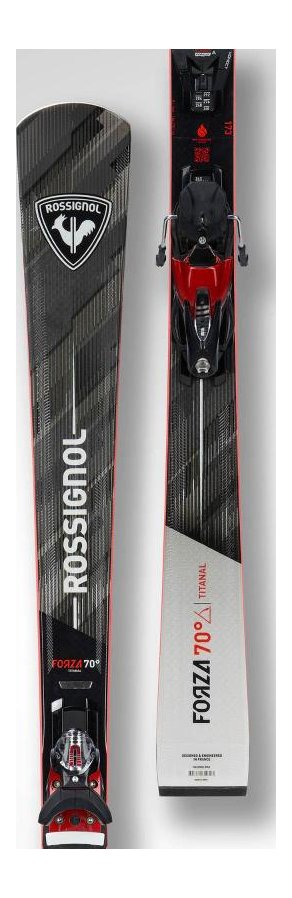
Overview
Rossignol's Forza line is its statement frontside family, pitched at skiers who treat groomers as a performance venue rather than a commute. The naming convention is a promise: each tier is labeled for the edge angle it is designed to support, and the 70 Ti sits at the top of the recreational range, one notch below full race equipment. For 2026/27 it carries the Titanal construction forward from the previous V-Ti version with the same mission: elite grip and acceleration on hard snow.
The shape is the unusual part. A 134mm shovel tapers through a V-shaped Titanal layer, widest at the tip, into a 77mm waist, a geometry Rossignol says plants the forebody early and pulls the ski across the fall line the moment you tip it. Line Control Technology, a vertical power rail down the spine, fights counter-flex at speed, and a Carbon Alloy Matrix weave with a PEFC-certified poplar core handles damping. The profile is effectively full camber with a whisper of tip rise, roughly 95 percent of the ski in contact. It sells as a system with Look's SPX 14 Konect GripWalk binding, one of the best-regarded heel-to-toe connections in skiing.
Key Specs
| Spec | Rossignol Forza 70 Ti |
|---|---|
| Dimensions | 134 / 77 / 110 mm at 173cm (retailer test spec) |
| Turn radius | ~14m at 173cm |
| Lengths | 163, 173, 181 cm |
| Profile | ~95% camber with short tip rise (Piste Rocker) |
| Construction | Poplar core, V-shaped tapering Titanal, Carbon Alloy Matrix, LCT power rail, full sidewalls |
| Weight | ~1,900g per ski at 173cm (retailer spec) |
| Binding | Look SPX 14 Konect GW system, DIN 4-14 |
| Ability level | Advanced to expert; strong intermediates in the 163 |
| Warranty | Standard Rossignol manufacturer coverage |
| Price | ~$1,050 with bindings (US retail) |
Sizing & Fit
Three lengths only, and the gaps matter. Published test feedback puts the 173 true to size for most advanced men from about 5'8" to 6'1", with testers advising against the 181 unless you are genuinely heavy, fast, or carrying race points; that length wants racer inputs all day. The 163 is the right call for lighter skiers and for strong intermediates using the Forza to sharpen technique, a use one tester explicitly endorsed. The SPX 14's DIN range of 4 to 14 covers everyone from cautious to expert settings, and the Konect plate keeps the ski's flex continuous underfoot. Boot-wise this chassis expects 110 flex or stiffer; pair it from our ski boots guide and get the mount done by a shop as with any system ski.
Where It Shines
- Turn initiation: the oversized shovel and V-shaped Titanal hook up the instant the ski tips, the trait test crews consistently lead with
- Hard-snow grip: full camber plus full sidewalls hold on surfaces that send skidders to the lodge, per published test scores for edge grip and stability
- Energy: testers describe strong rebound out of the turn, with quickness scoring among the highest in its test group
- Composure at speed: LCT and Titanal keep the ski tracking flat and quiet in big arcs
- Binding quality: the SPX 14 Konect is a race-bred binding with excellent elastic travel, a real inclusion at this price
Tradeoffs to Know
- Full camber punishes back-seat skiing; there is no rocker to bail you out, and published testers note the big shovel gets harder to engage in poor or sticky snow
- Versatility scores lowest among its test metrics: bumps are survivable, crud is work, powder is not the assignment, where the Peregrine 82 keeps more in reserve
- Expert testers talk about finding its speed limit, which means the ski eggs you on; self-control is part of the price
- Three lengths leave gaps; skiers between 163 and 173 must choose between quick and stable rather than splitting the difference
Who It's For
Advanced and expert skiers who measure a day in edge angles and peak speed: ex-racers, gates-on-Thursdays league skiers, and strong frontside skiers bored by forgiving equipment. It is also a legitimate technique sharpener in the 163 for ambitious intermediates who ski often and want a ski that reports every input honestly.
Who Should Skip It
Anyone who skids more than they carve; this ski makes that gap obvious. Skiers wanting quick, playful short turns over sustained speed are better matched to the Supershape e-Magnum. If your groomers routinely degrade into chop by noon, the Peregrine 82 handles the afternoon better, and developing carvers should start on the Wingman 78 C before graduating here.
How It Compares
The Head Supershape e-Magnum is the quicker, narrower scalpel: faster edge to edge, tighter natural arc, slightly more polished at moderate speeds. The Forza out-muscles it in long, fast turns; the Head out-dances it in short ones.
The Völkl Peregrine 82 trades a measure of the Forza's raw grip for 5mm of width, a touch of rocker, and genuine usability in mixed snow. Choose the Völkl for whole-mountain groomer days, the Forza for the days you chase your own top speed.
The Elan Wingman 78 C is the opposite philosophy: light, forgiving, and built to teach the carve the Forza assumes you already own. At roughly half the price it is the sensible first step, with this ski as the eventual destination.
See the full lineup in our guide: The Best Carving Skis of 2026/27.
Frequently Asked Questions
What does the 70 in Forza 70 Ti mean?
It refers to the edge angle the ski is designed to support, around 70 degrees in a deeply inclined carve, not to flex or waist width. Rossignol tiers the Forza line this way, with lower numbers aimed at gentler edge angles and progressing skiers.
Is the Forza 70 Ti too much ski for an intermediate?
At 173cm, usually yes. The full-camber profile rewards committed forward pressure and punishes hesitation. That said, published testers point to the 163 as a workable sharpening tool for strong, athletic intermediates who carve on easy terrain already. If that is not you yet, the Wingman 78 C is the smarter buy.
Can the Forza 70 Ti handle snow off the groomers?
Briefly. The 77mm waist and camber-dominant profile are optimized for hard, smooth snow; testers rate its flotation and crud manners near the bottom of its scorecard. It will cross a chopped section without drama, but a mixed-conditions skier should look at the Peregrine 82 or our all-mountain guide.