Jones Twin Sister Review
Affiliate disclosure: As an Amazon Associate we earn from qualifying purchases. Some links below are affiliate links, see our full disclosure. This breakdown is based on our independent research of current-season specifications and aggregated expert and user feedback.
The quick verdict: Six sizes, two stance setups, one of the cleanest builds in snowboarding, and test scores that sit near the top of every single category. The Twin Sister is the board for riders who refuse to pick a specialty; its only real weakness is having no single party trick. ~$600
Overview
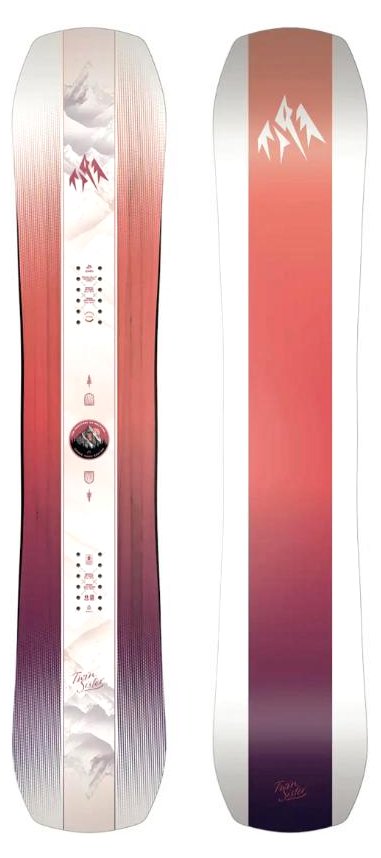
Jones built its reputation on big-mountain freeride boards, so the Twin Sister is the brand at its most approachable: a women's directional twin meant to do everything a resort can throw at it, with enough backcountry manners to earn its surname. It is the sister board to the long-running Mountain Twin, sharing that board's all-mountain freestyle brief in women's sizes and flex. Jones positions it for intermediate to advanced riders who want one deck for carving, switch riding, natural features, trees, and the occasional powder morning, and the independent test results back the claim: third of 24 women's all-mountain boards, scoring strongly everywhere without a weak category.
The construction is where Jones quietly shows off. CamRock puts camber between the feet and rocker at both ends, a progressive sidecut smooths turn entry and exit, and the base carries a subtle 3D spoon bevel at the nose and tail that softens catch points and helps the board plane in soft snow. Inside sits the Master Core, paulownia and poplar in equal measure, wrapped in biaxial glass with flax and carbon stringers and bonded with Durabond bio-epoxy. Sidewalls are recycled ABS, edges recycled steel, and the factory runs on solar power, details from the brand site that make this one of the lowest-footprint builds in the category. A sintered 8000 base ships factory-waxed.
Key Specs
| Spec | Jones Twin Sister |
|---|---|
| Sizes | 140, 143, 146, 149, 152, 155cm |
| Waist width | 238 to 248mm across the run (brand size chart) |
| Sidecut radius | 6.6 to 7.6m, progressive |
| Effective edge | 1072 to 1202mm |
| Shape | Directional twin with symmetrical effective edge |
| Profile | CamRock: camber between the feet, balanced tip and tail rocker |
| Flex | 3/5, medium (brand site) |
| Core | Master Core, 1:1 paulownia and poplar stringers |
| Laminates | Biax glass with flax and carbon stringers, Durabond bio-epoxy |
| Base | Sintered 8000, factory waxed with natural wax |
| Rider weight | 90-140 lbs (140) up to 120-170 lbs (155), per brand size chart |
| Inserts | 2x4 with separate Freeride and Freestyle insert packs |
| Warranty | 2 years, plus 1 more with registration (brand site) |
| Price | ~$600, deck only (retailer listings) |
Sizing & Fit
Six sizes between 140 and 155cm is the broadest run in this guide, and the published weight ranges overlap by design, so most riders fit two or even three sizes. Jones's own advice pattern holds: shorter for trees, switch, and freestyle intent, longer for speed and float. The dual insert packs are the practical star. Mount on the Freestyle pack and the board rides centered like a true twin; shift to the Freeride pack and you get a setback stance that noses up in powder. Waists reach 248mm at 155, friendly to boots around US women's 10. Medium-flex bindings suit it; the biax glass keeps torsion easy, and an overly stiff binding fights that intent.
Where It Shines
- Category balance: top-five scores across carving, trees, switch, jumps, and powder in the big independent women's test
- The catch-free, easygoing turn feel that the 3D spoon bevel and progressive sidecut are designed for, echoed across published reviews
- Genuine twin-like switch riding with a freeride fallback via the two insert packs
- The most sustainable construction here: bio-resin, recycled sidewalls and edges, solar manufacturing, per the brand site
- A size for nearly everyone, 90 lbs to 170 lbs across the run
Tradeoffs to Know
- No standout specialty: reviewers rank it near the best at everything and the outright best at nothing
- Biaxial glass keeps it friendly but surrenders some torsional snap; hard carvers will notice next to the Feelgood Camber
- Edge hold on true ice runs a touch behind the Hell Yes in the same test series
- Rail and jib performance scored lower; this is not the board for a park-rat season
Who It's For
Riders from progressing intermediate to advanced who want a single board that never feels like the wrong choice. It suits the rider whose season mixes family groomer days, tree laps with friends, a powder weekend, and a few side-country hikes, and it is the safest gift-buying pick in this guide because its weight-range coverage and friendly flex fit so many people.
Who Should Skip It
Riders chasing maximum edge grip or maximum speed should go Hell Yes or Feelgood Camber respectively. If playful looseness matters more than all-round polish, the Infinity delivers more of it. And dedicated park riders need a true freestyle deck, which none of these four is.
How It Compares
The YES Hell Yes is the sharper tool: better edge hold, snappier carves, a slightly higher skill floor. Choose the YES if you ride firm snow often; choose the Twin Sister for a friendlier flex and more sizes.
The Burton Feelgood Camber out-grips and out-runs it everywhere fast and firm, at the price of all the forgiveness the Jones is built around. These two sit at opposite ends of the demanding-to-friendly spectrum.
The Never Summer Infinity matches its medium flex but feels looser and more playful between turns, with a three-year warranty. The Jones counters with better switch riding and the stance-flexibility of its dual insert packs.
See the full lineup in our guide: The Best Women's Snowboards of 2026-27.
Frequently Asked Questions
What is the difference between the Twin Sister and the Mountain Twin?
They share the same all-mountain freestyle concept, CamRock profile, and construction philosophy. The Twin Sister runs women's sizes from 140 to 155cm with narrower waists and a flex tuned for lighter riders, while the Mountain Twin covers longer, wider sizes.
Can the Twin Sister handle real powder days?
Resort powder days, comfortably, especially mounted on the Freeride insert pack with the stance set back. The spoon-beveled nose planes well for a twin-ish shape. For regular deep days or splitboard-adjacent missions, Jones's more directional freeride shapes are the better tool.
Is it a good board to progress on?
One of the best in the category. The medium flex, rockered contact points, and catch-reducing base bevel forgive developing technique, while the camber underfoot and quality base leave plenty of performance to grow into. Strong beginners buying their first serious board land here often.