Atlas Montane Review: Specs, Sizing and Verdict
Affiliate disclosure: As an Amazon Associate we earn from qualifying purchases. Some links below are affiliate links, see our full disclosure. This breakdown is based on our independent research of current-season specifications and aggregated expert and user feedback.
The quick verdict: The do-most-things classic: a wide, quiet Nytex deck for fresh snow, spring-loaded suspension that walks more naturally than anything else in its class, and solid climbing hardware for about $150 less than the technical benchmark. ~$250
Overview
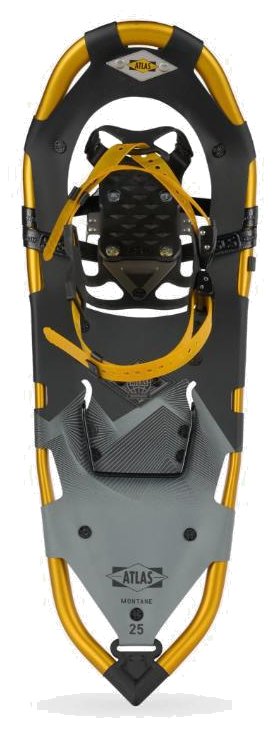
Atlas has built snowshoes in the Pacific Northwest tradition since 1990, and the Montane is its backcountry mainstay: the shoe Atlas points at people who hike varied winter terrain and want one pair for all of it. It is a classic tubular-frame design done carefully. The aluminum Reactiv frame changes cross-section from round to elliptical where loads concentrate, the Nytex deck is wide enough to float fresh snow, and the whole platform hangs from Atlas's signature Spring-Loaded Suspension: steel coils that let the tail drop with each stride instead of slapping the deck flat.
That suspension is the thing testers keep singling out. CleverHiker rates the Montane its all-rounder pick and credits the natural walking feel; Treeline Review lists it among the top shoes of the season for mountain terrain. It is not the grippiest shoe on bulletproof ice and not the absolute flotation king, but it does 85 percent of what both specialists do at a price comfortably below either ambition.
Key Specs
Figures below come from Atlas's product page for the 2026/27 Montane; weights are from published reviews, as Atlas does not list them.
| Spec | 25 in | 30 in | 35 in |
|---|---|---|---|
| Load range | 120-200 lb | 150-250 lb | 180-300+ lb |
| Weight per pair | ~4 lb | ~4 lb 5 oz | heaviest in line |
| Heel lift | 19° | 19° | 19° |
| Women's version | Montane Elektra, shorter and narrower sizes | ||
Frame: Reactiv aluminum, round-to-elliptical cross-section · Decking: Nytex nylon · Suspension: Spring-Loaded (steel coils) · Binding: Wrapp-BC with crampon-style yoke and roller buckles · Traction: All-Trac toe crampon, StabiLock weight-activated rear teeth · Heel lift: 19°, stores flat · Price: ~$250
Sizing, Fit and Compatibility
The three men's lengths ladder cleanly by total load: 25 inches to 200 pounds, 30 to 250, 35 for 300-plus, with Atlas counting body plus gear. Most buyers between sizes should take the smaller one; the Montane's deck is already wide for its length, so it gives up less float by rounding down than narrow shoes do. Women and lighter hikers get the Montane Elektra, a genuinely resized version rather than a recolor.
The Wrapp-BC binding uses a crampon-style yoke around the toe and roller-buckle straps over the foot and behind the heel. It takes any waterproof hiking or winter boot, holds narrow boots noticeably better than most strap systems, and is fully field-repairable. The cost is time: two buckles per foot to set each outing, slower than MSR's set-once Paragon mesh, and the long strap tails want tucking before they slap your gaiters. Poles with snow baskets, as with every shoe in this guide, are strongly recommended.
Where It Shines
- Natural stride: the spring suspension lets the tail drop and the deck flex with your gait, the most walkable classic-frame shoe per CleverHiker's testing
- Fresh-snow flotation: the wide Nytex deck floats day-pack loads in new snow with margin, a consistent theme in owner feedback
- Climbing hardware: All-Trac front points plus StabiLock rear teeth and a 19° heel lift handle rolling climbs confidently
- Durability economics: aluminum frame, replaceable straps and a field-simple binding make it a long-service shoe at a mid-range price
Tradeoffs to Know
- Strap bindings take longer to put on than mesh or ratchet systems, and the long tails flap until tucked
- On sustained icy sidehills it cedes grip to edge-rail designs; this is a backcountry shoe, not an ice shoe
- The springy suspension has a learning curve on hard, fast descents, where some reviewers prefer a fixed pivot
- No modular tails: the size you buy is the flotation you own
Who It’s For
Hikers who genuinely cannot predict their terrain: woods, meadows, moderate climbs, the occasional powder dump. It suits anyone stepping up from rental-grade shoes who wants backcountry capability without paying the full technical premium.
Who Should Skip It
Skip it if your winters are mostly steep and icy; the MSR Lightning Ascent is worth the extra $150 there. Skip it too if maximum float for a heavy load is the whole brief, where the Tubbs Mountaineer's 36-inch size has no rival in this group.
Frequently Asked Questions
What sizes does the Atlas Montane come in?
The men's Montane comes in 25, 30 and 35 inch lengths covering roughly 120 to over 300 pounds of combined body and pack weight. The women's version, the Montane Elektra, runs shorter and narrower with a binding shaped for smaller boots.
What is the Spring-Loaded Suspension on Atlas snowshoes?
The binding hangs from steel coil springs rather than a fixed pivot or strap hinge. The springs let the tail drop and the shoe flex with your natural stride, damp the slap on hardpack, and snap the deck back under your foot when you step over logs or rocks.
Is the Atlas Montane good for icy terrain?
It handles moderate ice well: the All-Trac toe crampon has front and rear points and the StabiLock rear teeth engage under load on descents. For sustained icy sidehills and technical steeps, edge-rail designs like the MSR Lightning Ascent still hold better, per published comparisons.
How It Compares
See how it stacks up in our full guide: The Best Snowshoes of 2026/27.
Choose the MSR Lightning Ascent instead if steep, icy terrain is a regular feature of your routes and the extra $150 buys traction you will actually use.
Choose the Tubbs Mountaineer instead if you carry the heaviest pack in the group through the deepest snow; its top size is rated to 300 pounds.
Choose the MSR Evo Trail instead if packed trails are your norm and $180 of near-indestructible simplicity covers the brief.