Rossignol Evo 70 HV+ Review: Specs, Sizing and Verdict
Affiliate disclosure: As an Amazon Associate we earn from qualifying purchases. Some links below are affiliate links, see our full disclosure. This breakdown is based on our independent research of current-season specifications and aggregated expert and user feedback.
The quick verdict: The easiest-entry, most forgiving first boot in its class, and cheap enough to beat two or three seasons of rental fees. Wide, warm, and honest about what it is. ~$250
Overview
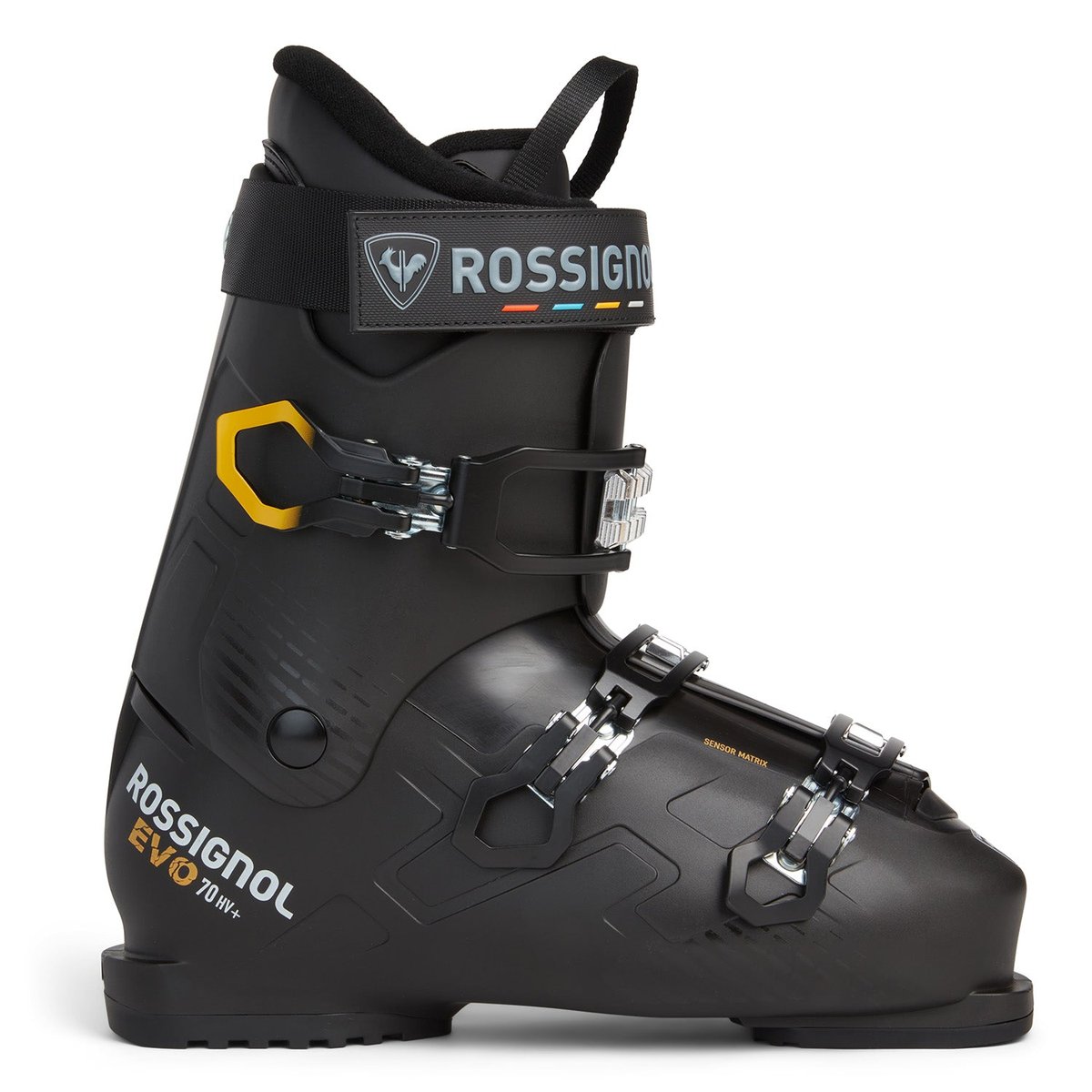
The Evo 70 HV+ is Rossignol's high-volume entry boot: a soft 70 flex, a 104mm last that qualifies as super wide, and a rear-opening shell that makes it far easier to pull on than most ski boots. Three micro-adjustable buckles and a wide power strap keep the closure simple, and the welded liner sole holds warmth better than typical budget liners. Switchback Travel calls it a well-rounded option for true beginners at a good price. The women's counterpart in Rossignol's line is the Kelia 50, with a softer 50 flex on the same wide, comfort-first recipe.
Where It Shines
- The rear-opening shell makes it one of the easiest boots to get on and off anywhere near this price
- Soft flex and generous fit are gentle on first-season legs and feet
- Warmer than most budget boots thanks to the welded liner sole
- Costs less than a few weekends of rentals
Tradeoffs to Know
- The basic liner packs out fast and offers little fit customization
- A 104mm last is sloppy on narrow or average feet
- You will outgrow it within a couple of seasons of steady progression
Who It’s For
True first-timers and early intermediates with wide or high-volume feet who want maximum comfort at minimum cost. Narrower feet should look at the Salomon S/Pro Supra 90 GW instead.
Key Specs by Size
Figures are approximate and drawn from Rossignol’s published spec sheet (via rossignol.com) and current retailer listings. Rossignol quotes the 104mm last at shell size 26.5; every full size up or down adds or removes about 2mm of forefoot width, which is why the big sizes feel so roomy.
| Mondopoint | Approx. US men’s shoe | Approx. forefoot width | Notes |
|---|---|---|---|
| 24.5 | ~6.5 | ~100mm | Smallest adult size; shares a shell with 25.5 |
| 25.5 | ~7.5 | ~102mm | Same shell as 24.5 with a thicker boot board |
| 26.5 | ~8.5 | 104mm | Reference size for the quoted 104mm last |
| 27.5 | ~9.5 | ~106mm | Most common size on the shelf |
| 28.5 | ~10.5 | ~108mm | Shares a shell with 29.5 |
| 29.5 | ~11.5 | ~110mm | |
| 30.5 | ~12.5 | ~112mm | Large sizes are where the HV+ really earns its name |
| 31.5 to 33.5 | ~13.5 to 15.5 | ~114 to 118mm | Few beginner boots go this big; this one does |
Across all sizes: 70 flex, three micro-adjustable alloy buckles plus a 35mm hook-and-loop power strap, a polyolefin shell and cuff that open at the rear for easy entry, a Comfort Fit liner with a welded sole for warmth, and replaceable ISO 5355 alpine (DIN) soles. There is no walk mode and no GripWalk option on this model. Rossignol does not publish a weight; expect it to sit in the typical 1.9 to 2.1kg per boot range for a plastic entry-level shell.
Sizing and Fit
Ski boots are sized in mondopoint, which is simply your foot length in centimetres. Measure both feet standing, heel against a wall, and take the longer one. A 27.0cm foot goes in a 27.5 boot; do not round up to the next size for comfort. Entry boots like the Evo 70 pack out noticeably in the first ten days, so a boot that feels merely snug on day one will feel right by the end of your first week. A boot that feels perfect in the shop will usually feel sloppy by mid-season, and sloppy boots are the number one reason beginners struggle to control their skis.
The 104mm last is the point of this boot. If your foot measures 100mm or more across the ball, or you have a high instep and find most boots crush the top of your foot, the Evo 70 HV+ will feel like a relief. If your foot is average (roughly 97 to 100mm) it will still work, but you will rely on the buckles and strap to take up the slack, and heel hold suffers once the liner packs out. Narrow feet should look elsewhere. Because the shell opens at the rear, the fit is more about the liner than the shell, so a heat-moldable aftermarket footbed is the cheapest upgrade you can make.
Binding compatibility is simple: the ISO 5355 alpine soles fit every standard alpine binding and every GripWalk binding, since GripWalk bindings accept both sole types. The only bindings that will not take the Evo 70 are touring-specific pin or tech bindings, which a beginner has no reason to own.
Who Should Skip It
Skip the Evo 70 HV+ if your feet are narrow or average and you have no trouble with regular 100mm boots; you will be paying for volume you cannot use, and the K2 BFC 80 or Salomon S/Pro Supra 90 will hold your heel better. Skip it if you already ski parallel on blue runs most of the day, because a 70 flex folds under a confident intermediate and the Nordica Speedmachine 3 100 or Atomic Hawx Magna 90X will carry you further. Skip it if you weigh much over 200 lb and ski aggressively, for the same reason. And skip it if you want GripWalk soles for walking around the village, since this model only comes with flat alpine soles.
Evo 70 HV+ vs. K2 BFC 80 vs. Salomon S/Pro Supra 90
These three are the obvious shortlist for a first boot, and they split neatly by foot shape and ambition. The K2 BFC 80 is the closest rival: a 103mm wide last, a slightly stiffer 80 flex, a heat-moldable shell, GripWalk soles included, and a Hands Free Entry instep that makes it nearly as easy to put on, for around $300 to 400. It is the better boot for a wide-footed beginner who plans to progress quickly or who wants to walk comfortably in the car park. The Salomon S/Pro Supra 90 GW is a different animal: a 100mm medium last, a 90 flex, four buckles and a heat-moldable liner and shell, at roughly $420. It suits average feet and intermediates who already know they will stick with the sport. The Evo 70 HV+ wins on price, warmth and sheer ease of entry. If you have very wide or high-volume feet, you are on a tight budget, or you only ski a week a year, it is the right call; if you ski more than that, spend the extra on the BFC 80.
Frequently Asked Questions
Is the Rossignol Evo 70 HV+ a good beginner boot?
Yes. A 70 flex, a very wide 104mm last and a rear-opening shell make it one of the softest, roomiest and easiest boots to get on in its price range, which is exactly what a first-season skier needs. It is less suited to progressing intermediates, who will want more support.
What size Rossignol Evo 70 should I buy?
Buy your mondopoint size, which is your foot length in centimetres rounded up to the nearest half size. Do not size up for comfort; the liner packs out quickly and a boot that is too big is harder to ski than one that is snug.
Does the Evo 70 HV+ work with GripWalk bindings?
Yes. It has standard ISO 5355 alpine soles, which fit both traditional alpine bindings and GripWalk-compatible bindings. It does not come with GripWalk soles itself, so walking on hard ground is a little slippery.
Is there a women’s version?
Rossignol’s women’s equivalent is the Kelia 50, a softer 50 flex boot on the same wide, comfort-first design with a lower cuff. Women with larger feet or who want a bit more support can also ski the Evo 70 HV+, since the sizing runs small enough.
How It Compares
This boot is a pick in our guide: The Best Ski Boots of 2026-27. A stiffer, wide-fit alternative also joined the lineup: the Head Edge 110 HV BOA.
See where it fits in our Ski Boot Sizing Guide. Other boots from that guide: Salomon S/Pro Supra 90 GW · Nordica Speedmachine 3 100 · K2 BFC 80 · Atomic Hawx Magna 90X GW.