Capita Mercury Review
Affiliate disclosure: As an Amazon Associate we earn from qualifying purchases. Some links below are affiliate links, see our full disclosure. This breakdown is based on our independent research of current-season specifications and aggregated expert and user feedback.
The quick verdict: The all-mountain board for riders who treat groomers as a racetrack: locked-in carves, real speed stability, and Austrian factory build quality. It asks for commitment and repays it. ~$700
Overview
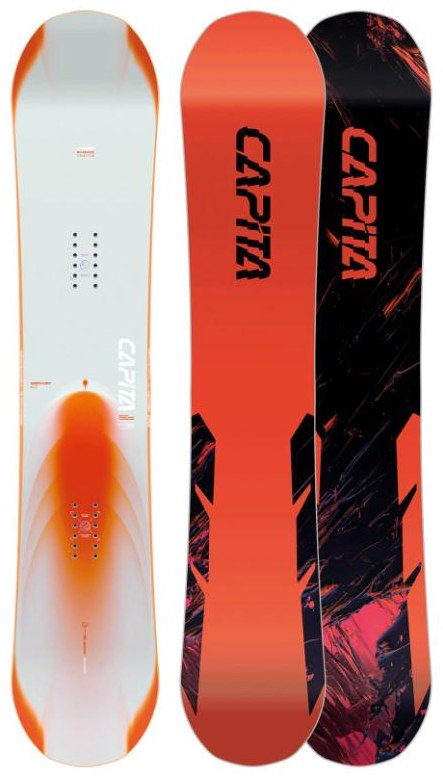
Capita made its name on park boards like the DOA, but the Mercury is its statement that the brand can build for the other side of the mountain too. In the lineup it sits above the DOA as the aggressive all-mountain option, below the full freeride and splitboard decks, and Capita pitches it at advanced riders who want one board for fast resort laps with freeride ambitions. Like every Capita, it comes out of the Mothership, the company's renewable-energy factory in the Austrian Alps.
The heart of the board is the Resort V2 profile: camber through the inserts for grip and pop, reverse-camber zones toward the ends for float and forgiveness, finished with flat kicks at tip and tail. Add a 12.5mm setback, a fast sintered HyperDrive base, and reinforcements over a wood core, and the result is a board that published reviews consistently describe as one of the best carving and charging decks in the all-mountain category.
Key Specs
| Spec | Capita Mercury |
|---|---|
| Flex | Medium-stiff (about 6.5/10) |
| Profile | Resort V2: camber underfoot, reverse camber and flat kick at the ends |
| Shape | Directional twin, 12.5mm setback |
| Sizes | 147, 150, 153, 155, 157, 159, 161 + 156W, 158W, 160W, 162W (brand site) |
| Base | Sintered (HyperDrive) |
| Made in | Capita Mothership, Austria (renewable energy) |
| Rider level | Advanced intermediate to expert |
| Warranty | Capita limited warranty |
| Price | ~$700 (brand site) |
Sizing & Fit
Eleven sizes cover most riders, with four wide options for US 11.5+ boots. The Mercury rides true to size, and the usual advice from retailer fit guides is to resist sizing down: the board's personality is stability, and a too-short Mercury gives up its main advantage without becoming a park board. Riders between sizes who want a bit more agility in trees can take the shorter length; anyone prioritizing open-terrain speed should take the longer one. Pair it with stiffer bindings and supportive boots, since soft freestyle gear mutes exactly the response you are paying for; our bindings guide and boots guide have matched options.
Where It Shines
- Carving: the camber-dominant profile locks an edge and holds it through high-speed turns, a standout in published reviews
- Stability in chop and at speed that softer all-mountain boards cannot match
- Accessible pop for a board this composed; it ollies harder than its damp feel suggests
- Build quality and finish from the Austrian Mothership factory, with a reputation for durability
- Decent powder manners for a resort deck thanks to the setback and rockered nose
Tradeoffs to Know
- Demands technique; reviewers note it gets unforgiving when you ride it lazily or in the back seat
- Slow-speed maneuverability is limited, so tight trees and cat tracks take more work than on the Mountain Twin
- Switch riding is workable but needs attention through transitions; true twins spin easier
- At ~$700 it is the most expensive board in our lineup, and it sells out early most seasons per retailer listings
Who It's For
Strong riders whose favorite part of the day is the fast lap: first chair, empty corduroy, trenches on every pitch. It suits the aggressive all-mountain rider who occasionally hits a kicker but has no patience for a washy board at 40mph, and anyone who wants freeride composure without giving up a usable tail for the odd switch landing.
Who Should Skip It
Newer riders and the butter-and-jib crowd. The stiffness that makes the Mercury brilliant at speed makes it a chore to press, and its catch-resistant profile only partly offsets how directly it punishes sloppy technique. If your riding lives below 25mph or revolves around playfulness, the Yes Standard or Capita's own DOA (see our DOA breakdown) will be more fun per dollar.
How It Compares
The Jones Mountain Twin is ~$100 cheaper, a touch softer, and far more forgiving of off days. Choose the Jones for balanced all-terrain versatility; choose the Mercury when carving performance and speed stability top the list.
The Yes Standard is the opposite personality at ~$150 less: looser, surfier, easier to butter, with a powder trick the Mercury lacks. Riders who finish every turn go Mercury; riders who slash and play go Standard.
The Salomon Assassin costs ~$50 less and swaps some of the Mercury's charge for pop and spin-friendliness. Jump-line regulars pick the Assassin; the Mercury wins everywhere the speedometer matters.
See the full lineup in our guide: The Best All-Mountain Snowboards of 2026-27.
Frequently Asked Questions
Is the Capita Mercury too stiff for intermediates?
Solid intermediates who ride with intent will grow into it quickly; its medium-stiff flex is demanding only compared to softer all-mountain decks. Riders still mastering linked turns or who ride mostly at slow speeds will find it unforgiving and should look at softer options first.
What is Capita's Resort V2 profile?
Resort V2 combines camber underfoot and between the bindings with reverse-camber zones toward the tip and tail, plus flat kick sections at the ends. The camber supplies grip and pop, while the rockered ends add float and take the edge-catch anxiety out of rough snow.
Does the Capita Mercury work in powder?
For a resort daily driver, yes. The 12.5mm setback and rockered nose keep it workable in up to a foot of fresh, per aggregated reviews. For regular deep days a dedicated tapered board still floats with less effort.