Deuter Freerider 30 Review: Specs, Sizing and Verdict
Affiliate disclosure: As an Amazon Associate we earn from qualifying purchases. Some links below are affiliate links, see our full disclosure. This breakdown is based on our independent research of current-season specifications and aggregated expert and user feedback.
The quick verdict: A true 30-liter winter pack with rear access and an avy compartment at a flat kilogram, the lightest full-featured option we found. ~$200
Overview
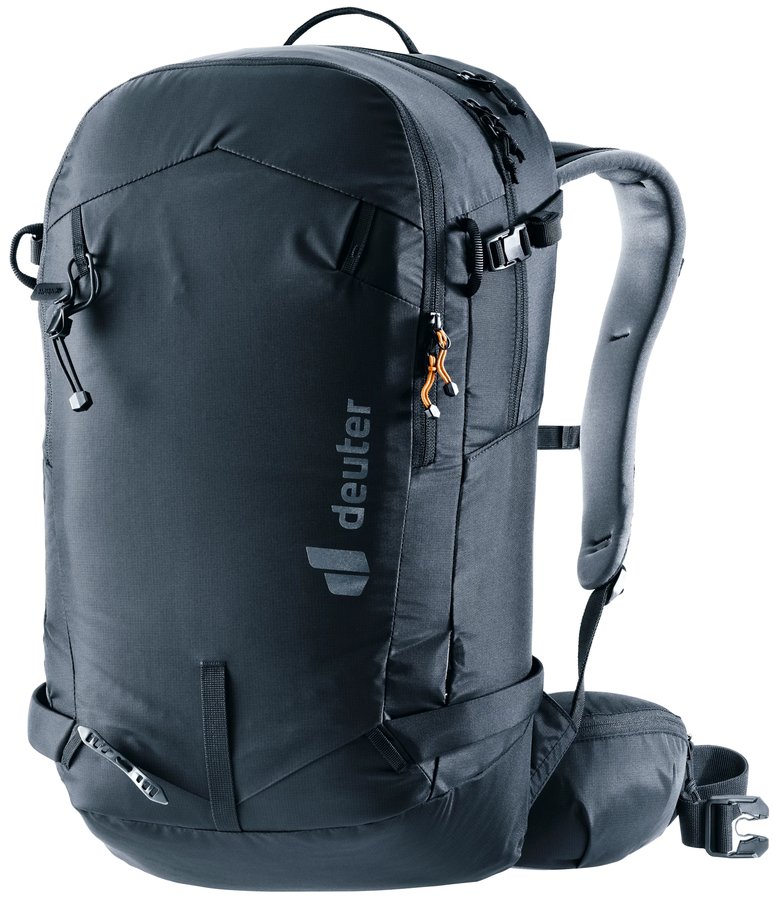
Deuter’s current Freerider is an exercise in subtraction done right. The LiteSnow back system pares the suspension to a flexible Delrin U-frame and sculpted EVA pads shaped so snow cannot pack into them, which keeps both the weight and your back dry. Despite the diet, the feature list reads like a heavier pack: U-zip rear access to the main compartment, a dedicated avalanche gear pocket, fleece goggle pocket, wet compartment, helmet holder, and carry options for skis, board, or snowshoes. The shell is 100% recycled yarn, made without added PFAS.
Where It Shines
- Roughly two-thirds the weight of comparable 30L touring packs
- Snow-shedding back panel genuinely keeps your base layer drier
- Rear U-zip opens wide, no unloading skis to reach the bottom
- Safety details everywhere: whistle, SOS label, high-vis avy pocket
- Strong sustainability credentials for buyers who weigh that
Tradeoffs to Know
- The light suspension tops out around 8kg; heavy carriers want the Soelden 32 or Dawn Patrol
- Thinner materials trade some abrasion resistance for the weight savings
- Single back length
Who It’s For
Fast-and-light tourers, freeriders who count grams on the bootpack, and anyone whose shoulders complain by 2pm. Skiers who routinely haul rope, rescue gear, or camera equipment should pick a burlier frame.
Key Specs and Sizes
Figures are approximate and drawn from Deuter’s published spec sheet (via deuter.com) and retailer listings at Backcountry and Snowleader. The Freerider 30 comes in one back size.
| Spec | Detail |
|---|---|
| Volume | 30L (about 1,830 cu in) |
| Weight | ~1,000g (about 2.2 lb) |
| Dimensions | 56 x 33 x 18cm (about 22 x 13 x 7 in) |
| Fabric | 200D 2x2 polyamide ripstop, 100% recycled yarn, PFAS-free DWR |
| Back system | LiteSnow: spaced EVA pads under snow-shedding spandex, flexible Delrin U-frame, padded hip fins |
| Torso range | One size, back length 38-54cm (15-21 in), for body heights of roughly 158-195cm (5’2” to 6’5”) |
| Carry systems | Diagonal or side (A-frame) ski carry, front snowboard or snowshoe carry, ice axe attachment, rope strap, detachable mesh helmet holder |
| Avy pocket | Dedicated front compartment for shovel and probe |
| Pockets | Fleece-lined goggle pocket, glasses stow on shoulder strap, two zipped hip-fin pockets, internal zipped mesh pocket, wet compartment, key clip |
| Hydration | Compatible with reservoirs up to 3L (not included) |
| Recommended load | 4-8kg (about 9-18 lb) |
| Warranty | Deuter Promise lifetime repair service; Deuter’s US site lists a lifetime warranty |
| Price | ~$200 list |
Access is through both a zipped top-loader and a rear U-zip, there is a safety whistle and an SOS label, and the pack carries bluesign and Green Button certification. Two stablemates share the same LiteSnow back and fabric: the women’s Freerider 28 SL trims the back length to 38-48cm (15-19 in) for heights of about 158-178cm, weighs ~980g and lists at ~$200, while the Freerider Pro 32+10 adds a roll-top that expands 32L to 42L, a second ice axe loop and a 6-10kg load rating at ~1,100g and ~$220. Street prices on the plain 30 hover near list, with outgoing colourways dipping below it.
Sizing and Fit
There is only one size, so the question is whether your back fits inside Deuter’s 38-54cm window. Measure from the bony bump at the base of your neck (C7) to the top of your hip bones; most adults between about 5’2” and 6’5” land in range. The hip fins are padded but light, and they are meant to stabilise rather than carry weight, so a tall skier with a long torso at the 54cm end should expect the belt to ride at or slightly above the hip bones rather than wrapping them. Shorter women with a back length under 44cm usually get a cleaner fit from the 28 SL, which shares every feature but sits lower and narrower across the shoulders.
Load the pack with its 4-8kg rating in mind. A beacon, shovel, probe, skins, 1L of water, a puffy and a snack sits around 4-5kg, which is where the LiteSnow suspension feels best; the Delrin U-frame and spaced EVA pads give shape without a stiff sheet, so the pack moves with you on a bootpack. Push past 8kg with a rope, crampons and camera gear and the shoulder straps start taking the load the hip fins can’t. The side straps take fat skis, the front straps hold a snowboard or snowshoes, and reviewers note the mesh helmet holder can’t be used at the same time as the front board carry.
Who Should Skip It
Skip the Freerider 30 if you regularly haul rope, rescue kit or a heavy camera setup, because the 8kg ceiling is real; the Black Diamond Dawn Patrol 32 carries more weight with a stiffer frame. Skip it if you ride lifts and sidecountry laps and never tour, since you are paying for a touring feature set you will not use; the Dakine Heli Pro 20L is smaller, cheaper and quicker to live out of. And skip it if you want airbag protection in the pack itself, which no Freerider offers; the Mammut Tour 30 Removable Airbag 3.0 is the pick in that case.
Freerider 30 vs. Black Diamond Dawn Patrol 32 vs. Osprey Soelden 32
All three are 30-32L touring packs with avy pockets and back-panel access, and the price spread tells most of the story. The Osprey Soelden 32 at ~$195 is the value play, a touch cheaper than the Freerider’s ~$200 with a more conventional padded back that carries a bit more comfortably but soaks up snow and weight. The Black Diamond Dawn Patrol 32 at ~$270 is the burliest, built for guides and heavier loads, and you pay about 70 dollars and a few hundred grams for it. The Freerider 30 is the lightest of the three at a flat kilogram and the only one with a back panel designed not to hold snow. Pick the Soelden if you want the most pack for the least money and don’t mind the weight; pick the Dawn Patrol if you carry rope and rescue gear or ski more than forty days a year; pick the Freerider 30 if you tour fast and light and value a dry back over maximum durability.
Frequently Asked Questions
Is the Deuter Freerider 30 good for beginners?
Yes. It has everything a first touring pack needs, including a proper avy compartment, ski and board carry and a hydration sleeve, at a mid-range price and without the complexity of an airbag system.
What size Deuter Freerider should I get?
The Freerider 30 is one size covering back lengths of 38-54cm (15-21 in). Women or anyone with a back under about 44cm should look at the Freerider 28 SL, and skiers who want a bigger overnight-capable pack should step up to the Freerider Pro 32+10.
Deuter Freerider 30 or Freerider Pro 32+10?
The Pro adds a roll-top that expands to 42L, a second ice axe loop and a higher 6-10kg load rating for roughly $20 and 100g more. Day tourers should take the 30; hut-to-hut skiers and climbers should take the Pro.
Is the Deuter Freerider 30 waterproof?
No. The 200D ripstop body has a PFAS-free DWR finish and the back panel sheds snow, so it handles storm days well, but the zips are not sealed and there is no rain cover, so keep electronics in a dry bag.
How It Compares
See how it stacks up in our full guide: The Best Ski Backpacks of 2026-27. Other picks from that list: Osprey Soelden 32 · Dakine Heli Pro 20L · Black Diamond Dawn Patrol 32 · Mammut Tour 30 Removable Airbag 3.0.