Head Kore 94 Ti Review: Specs, Sizing and Verdict
Affiliate disclosure: As an Amazon Associate we earn from qualifying purchases. Some links below are affiliate links, see our full disclosure. This breakdown is based on our independent research of current-season specifications and aggregated expert and user feedback.
The quick verdict: Head added two sheets of titanal to its famously light freeride ski, and the 2026 Kore grips and charges like a ski 300 grams heavier. ~$800 list, typically ~$680-750 on sale
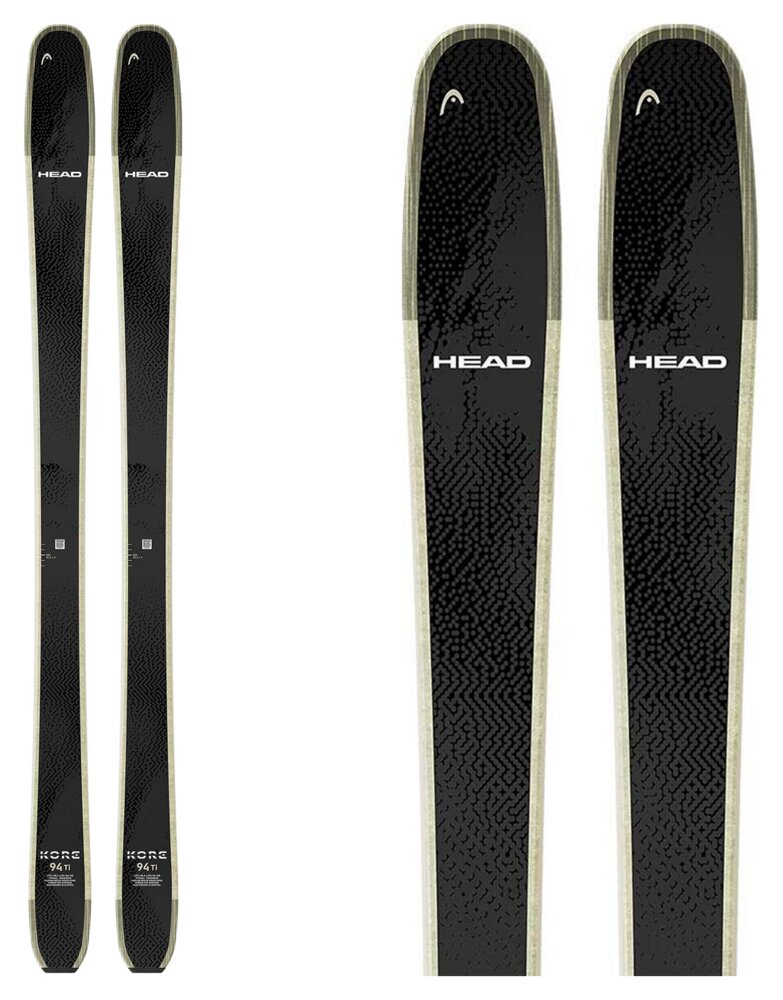
Overview
The original Kore made its name by being absurdly light for how hard it skied. For 2026 Head rebuilt it as the Kore 94 Ti: two titanal layers, a karuba and beech core, graphene reinforcement, and a redesigned tip-tail rocker profile with 50 percent camber underfoot. At roughly 1,900 g in the 177 it is still lighter than most metal skis, but the flex is deeper and the ride far quieter than earlier Kores. The 16.3 m radius likes finished, driven turns.
Where It Shines
- Race-bred edge grip in a ski light enough to tour on in a pinch
- Quiet and composed in refrozen chop where light skis chatter
- Balanced 94 mm waist keeps groomer quickness with real off-piste range
Tradeoffs to Know
- Less forgiving of back-seat skiing than the Rustler 9
- Among the priciest skis in our lineup at full price
- Firm flex demands commitment; lighter skiers may prefer a shorter length
Who It’s For
Advanced and expert skiers who drive the ski from the front and want maximum performance per gram, including anyone eyeing occasional backcountry use with a heavier setup.
Key Specs by Size
Figures are approximate and drawn from HEAD’s published specs (via head.com) and retailer listings at SkiEssentials and SkatePro. HEAD states one sidecut for the model, measured on the 177, and publishes a weight only for that length.
| Length | Tip / waist / tail | Radius | Weight per ski |
|---|---|---|---|
| 156 cm | 131-94-116 mm (stated at 177) | not published | not published |
| 163 cm | 131-94-116 mm (stated at 177) | 13.3 m | not published |
| 170 cm | 131-94-116 mm (stated at 177) | 14.7 m | not published |
| 177 cm | 131-94-116 mm | 16.3 m | ~1,875 to 1,930 g |
| 184 cm | 131-94-116 mm (stated at 177) | 17.9 m | not published |
| 191 cm | 131-94-116 mm (stated at 177) | 19.5 m | not published |
Across the line: a karuba and beech wood core between two sheets of titanal, a graphene strip, flax and fiberglass laminates, a flax-fibre hybrid topsheet for damping, bevelled mini-cap sidewalls and a structured UHM C sintered base. The profile is rocker-camber-rocker, roughly 30 percent tip rocker, 50 percent camber and 20 percent tail rocker by HEAD’s figures. The metal stops short of the tips and tails, which is part of why the ski stays light. It ships flat with no binding. List price is about $800; in autumn 2026 most retailers sit between roughly $680 and 750, and a few closeout listings have dipped to about $350.
Sizing and Fit
The 94 Ti skis close to its stated length: the rocker is modest and the camber is real, so the effective edge is long. Testers at SkiEssentials were split between “go up a length” and “true to size”, a decent sign it feels neither short nor unwieldy. Strong intermediates should take a length between chin and nose; advanced skiers who like speed go to the forehead or a touch over. That puts a 5’6” (168 cm) skier on the 163 or 170, a 5’9” to 5’11” (175 to 180 cm) skier on the 177, and a 6’1” (185 cm) or heavier skier on the 184. Weight matters too, because the titanal makes the flex firmer than the old carbon Kore: a 140 lb (64 kg) skier is usually happier on the 170, while a 200 lb (91 kg) skier can take the 184 without the tail washing out. The factory mount sits about 10 cm behind centre; leave it there.
The ski is sold flat, so you’ll need a binding with a brake around 100 mm; anything from 95 to 109 mm clears the 94 mm waist. A 12 or 13 DIN alpine binding suits most buyers, and since the ski is light enough to skin on now and then, a hybrid pin-and-alpine binding makes sense for occasional backcountry days. It won’t suit a park skier who wants a true twin, since the tail is only a partial twin, or a first-year skier who needs a softer flex.
Who Should Skip It
Skip the Kore 94 Ti if you want the playful, forgiving side of the category: the Blizzard Rustler 9 has more tip rocker and a looser feel that lets you skid and slarve without being punished. Skip it if your budget stops around $550, because the K2 Mindbender 90C gives up some high-speed composure but costs a couple of hundred dollars less and is easier to progress on. And skip it if you want a lively, energetic ski rather than a damp one; the Elan Ripstick 96 is similarly light but pops out of turns in a way the metal-laden Kore does not.
Kore 94 Ti vs. Völkl M7 Mantra vs. Nordica Enforcer 94
These are the metal skis of the all-mountain class, and they split on weight. The Völkl M7 Mantra, about $900 list for 2026/27, is the heaviest and most locked-in, with a tailored titanal frame and a three-radius sidecut that carves short on groomers and runs long when you open it up. The Nordica Enforcer 94, about $800 list and often ~$560 to 700 on sale, is the all-rounder: damp, stable and easier at moderate speeds than the Völkl, with more forgiveness in soft snow. The Kore 94 Ti, about $800 list and ~$680 to 750 on sale, trades a little of the Mantra’s bite and the Enforcer’s easygoing feel for a lighter ski that is less tiring over a full day. Pick the Mantra if you live on groomers and want the most edge hold. Pick the Enforcer if you want the most versatile ski and don’t mind the weight. Pick the Kore 94 Ti if you ski hard but want a light swing weight for bumps and trees, or one ski that can occasionally go uphill.
Frequently Asked Questions
Head Kore 94 Ti or Kore 94?
There is no non-Ti Kore 94 in the current line. The 2026 Kore 94 Ti replaced the previous Kore 93, which used a carbon and graphene layup with no metal. The Ti version adds two titanal sheets, a beech and karuba core and a flax topsheet, so it is a little heavier, noticeably quieter on firm snow and less twitchy at speed.
Is the Head Kore 94 Ti good for intermediates?
A strong, athletic intermediate with decent technique can enjoy it, especially in the 163 or 170. The firm flex rewards a forward stance and punishes sitting back, so a true beginner or a cautious intermediate will be happier on something softer.
What size Head Kore 94 Ti should I get?
Take a length between your chin and your forehead, leaning longer if you are heavy or fast and shorter if you are light or ski mostly bumps and trees. For most men between 5’9” and 6’0” that is the 177.
What brake width do I need for the Head Kore 94 Ti?
The waist is 94 mm, so a 100 mm brake is ideal. Anything from 95 up to about 109 mm clears the ski without dragging in a carve.
How It Compares
See how it stacks up in our full guide: The Best All-Mountain Skis of 2026-27. Other picks from that list: Völkl M7 Mantra · Blizzard Rustler 9 · Elan Ripstick 96 · K2 Mindbender 90C.